
Rescue food. Support people. Reduce waste.
Our volunteers collect surplus food for the Driven Forward Community Fridge, helping good food reach people in our community and keeping it out of landfill.
Our work and impact
Our volunteers collect surplus food from supermarkets, including Tesco and Waitrose, and frozen food from restaurants. Collections include fruit, vegetables, bread, cakes and food with a short shelf life.
We let our “community fridgers” know when food is short-dated so they can make informed choices. Our food-waste guide explains the difference between best-before and use-by dates.
Thinking of donating food? Please check what we can accept before bringing it along.
Our impact: a snapshot
A historical snapshot of our food collections, recorded from April 2019.
2,526
food collections
80,578 kg
food collected
193,566
meal equivalents
257,543 kg
reported CO₂ savings
“Meal equivalents” expresses the amount of food collected as an equivalent number of meals.
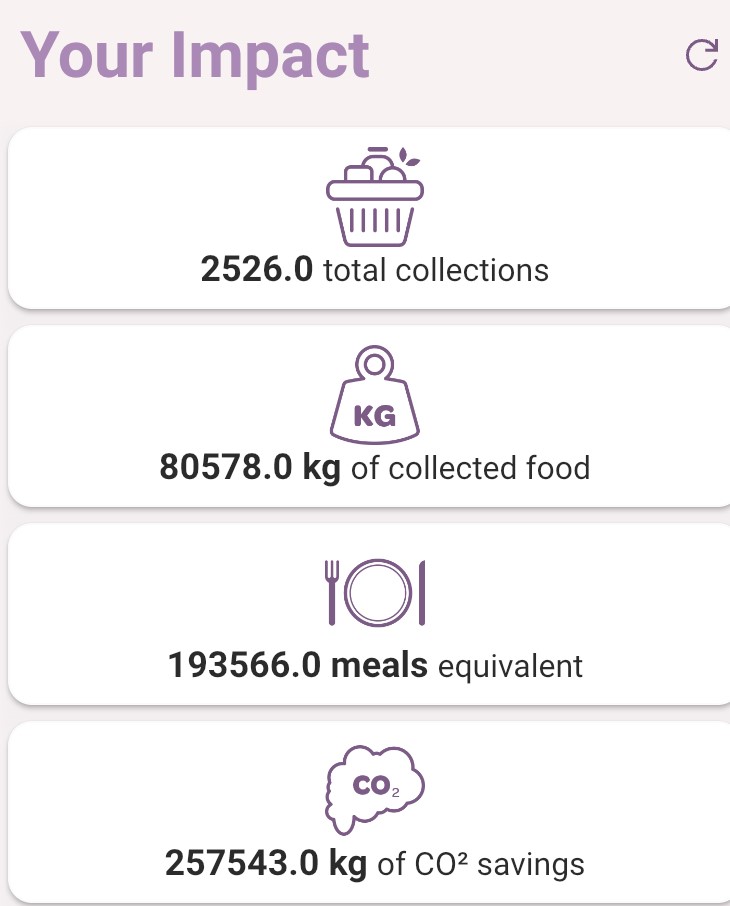
Select the impact graphic to enlarge it.
Supporting our community
We have also shared surplus food, drinks and useful goods with local groups and community activities:
- Community groups and churches: donated items for raffles and prizes.
- Local events, schools and community groups: surplus water and soft drinks, including donations to Windsor Boys’ School.
- The Baby Bank: nappies, wet wipes, surplus water and soft drinks.
- Raffles at Kerith Church: surplus donations to support community fundraising.
- Broom Farm Army Estate: surplus donated items.
- The family hub and social club on Hanover Way: surplus food.
We have also passed food unsuitable for people to a farm for its animals, and surplus bread to a local swan-support charity.
The bigger picture · Worldwide food waste
Why saving food matters
Sharing good food helps our neighbours and makes better use of the resources that went into producing it.
Good food, precious resources
Almost one fifth of food available to consumers worldwide was wasted in 2022, according to UNEP’s Food Waste Index Report 2024. This covers households, food services and shops, and includes inedible parts such as peels and bones.
A little kinder to our planet
Food loss and waste together account for an estimated 8–10% of annual global greenhouse gas emissions, as reported by UNEP in 2024. Preventing waste helps reduce that impact.
Source: UN Environment Programme, March 2024.
Small steps you can take
A few everyday ideas to help good food go further and explore your wider impact.
Give good food more time
Make the most of what you have with simple storage tips and a guide to best-before and use-by dates.
Explore food-saving tips →Small steps for a lighter footprint
Curious about your everyday impact? Explore ClimateHero’s carbon-footprint calculator for an estimate and ideas for reducing it.
It takes around five minutes, with questions about housing, travel and consumption.
Try ClimateHero’s calculatorGet involved
Our volunteers collect, sort and share surplus food, and welcome people to the community fridge. We’re grateful to everyone who helps. You can join in by volunteering or visiting a community fridge pop-up.